
Key takeaways
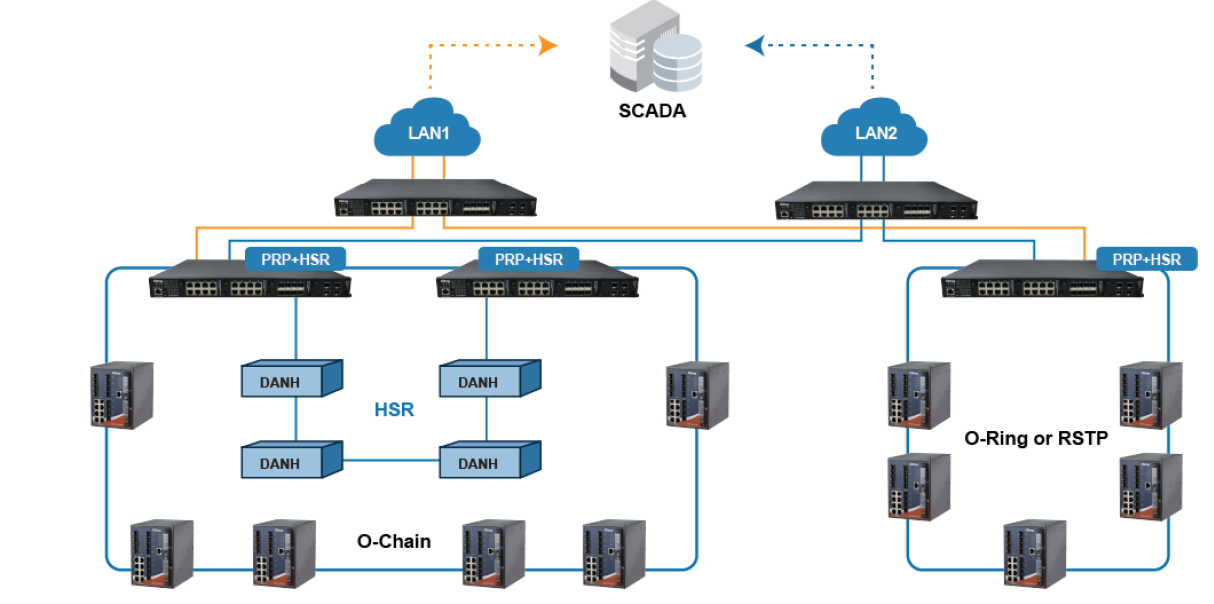
IEC 61850 is an international standard for substation automation that defines communication protocols enabling interoperability between protection relays, IEDs, merging units, and SCADA systems in digital substations. HSR (High-availability Seamless Redundancy, IEC 62439-3) and PRP (Parallel Redundancy Protocol, IEC 62439-3) are the two zero-recovery-time network redundancy protocols most widely adopted in IEC 61850 deployments.
- IEC 61850 digital substations rely on process bus and station bus networks for protection, control, and monitoring.
- HSR and PRP provide seamless redundancy for substation communications, supporting high network availability in different deployment scenarios.
- ORing RGS-PR9000, RGS-P9000, and IGS-P9084GPI industrial Ethernet switches deliver IEC 61850-3-certified, HSR/PRP-capable switching for utility-grade infrastructure.
This guide covers the design and deployment of IEC 61850-compliant substation communication networks using HSR and PRP redundancy architectures, as defined in IEC 62439-3 (2016 edition). It addresses process bus and station bus network design, redundancy strategy selection, cybersecurity requirements under IEC 62443-4-2 (2019 edition) and IEC 62351-6, and the deployment of ORing industrial Ethernet switches ??including the RGS-PR9000, RGS-P9000, and IGS-P9084GPI (all rated -40 to 75簞C, IEC 61850-3 certified) ??in modern digital substation environments. Intended for protection engineers, substation automation specialists, and network architects working on utility-grade communication infrastructure.
Related resources
- What is HSR/PRP? ??ORing Knowledge Base
- IEC 61850 and GOOSE, MMS Protocols ??ORing Knowledge Base
- What is IEC 62443? ??ORing Knowledge Base
- IEC 61850-3 Ethernet Switches ??ORing Product Page
- Power Utilities Solution ??ORing
- IEC 61850 Standard ??IEC Webstore
- IEC 62439-3 (HSR/PRP) ??IEC Webstore
- IEC 62443 Industrial Cybersecurity Series ??IEC